The FU Ori outburst of
PR Ori B
Contreras Peña et al. (2026)
Read More
The formation of planetary systems within the dust- and gas disks around young stars is one of the most exciting areas of astrophysical research. Using the latest astronomical telescopes, it is possible to detect such disk structures as spiral arms, rings, gaps, or vortices, whose origin may be explained by the gravitational effects of forming planets. By studying these disk structures, we can infer the presence and properties of otherwise invisible planets. However, this task raises several currently unanswered questions: e.g., how does the radiation from stars affect the material in the disk, or what structures would form in the disk in the absence of planets? Our project aims to address two key problems through the collaboration of a Hungarian and a Chinese research group: (1) What is the effect on the composition and distribution of the disk material when material is falling onto the protostar and energy is released, particularly during outbursts? (2) How can we determine the mass, orbit, and other properties of planets from the structures observed in circumstellar disks? The foundation of the research is the observation of disks across multiple wavelengths, which will allow us to analyze the distribution of dust particles and molecules. In parallel, we will study the long-term effects on disk evolution due to variable radiation from young stars. We will use numerical simulations to understand the impact of planets with different masses and orbits on the disk structures, creating a "template library" from the results. With artificial intelligence, we will constrain planet parameters. We will utilize world-class instruments, including ESO/VLTI, NASA/IRTF, ALMA, Gaia, and the James Webb Space Telescope. The data and conclusions obtained during this research will significantly contribute to a deeper understanding of the evolution of the solar system and other planetary systems around far-away stars.
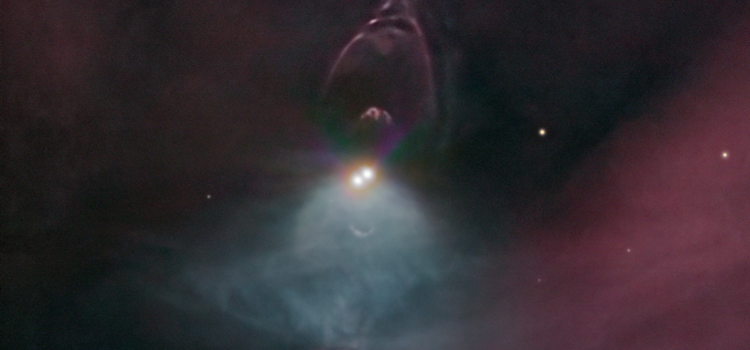
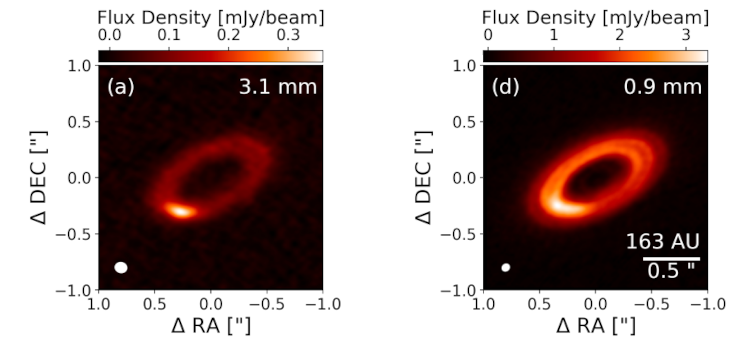
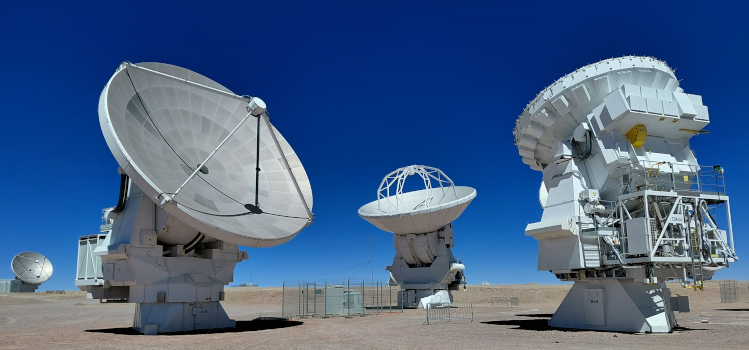
Prachi Chavan is part of the multi-wavelength dust analysis team of the accepted ALMA Large Program 2026.1.00994.L PEBBLES.
Read More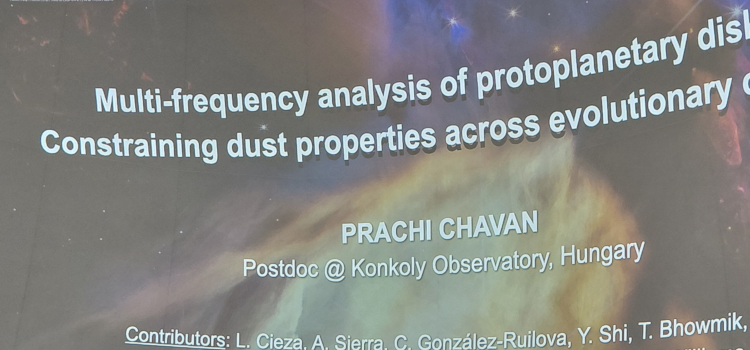
Prachi Chavan gave a contributed talk at the "Bridging It: Connecting Observations and Models of (Exo)planets and their Formation" conference in Heidelberg, Germany.
Read More
See also in Hungarian at this page. The HUN-REN press release can be accessed here in Hungarian and here in English.
Read More
ALMA
Read More